Reflection for November 14, 2021 by the Rev’d Dr. Wayne Fraser

War and Peace

I have always been uncomfortable at Remembrance Day services, whether in churches or at cenotaphs at 11am on the 11th day of the 11th month. It is meet and right to be uncomfortable, for it is not a comforting time or event to remember. My discomfort in youth stemmed from what seemed to me then a glorification of war, a celebration of the glory and honour of the sacrifice of fallen heroes. It was all a little unsettling, especially as history and literature so graphically show us the horror and injustice, the propaganda and atrocities, committed by all sides in conflict. Wilfred Owen summed up the feeling for many in the elegiac poem he wrote during WWI, “Dulce et Decorum Est”: if the reader could witness the gruesome pain and horror of a gas attack, Owen concludes, then “my friend, you would not tell with such high zest/ To children ardent for some desperate glory/The Old Lie: “Dulce et decorum est/Pro patria mori.” It is not sweet and gentle to die for one’s country; it is an insane, horrible, hellish, painful death.

On Remembrance Day we should talk of peace, not war, but it is so difficult, for our minds, our language, conditioned by centuries, more easily sing of arms and man than the way of peace.

Or so thought Ernest Hemingway’s narrator in the finest novel to emerge from the First World War, A Farewell to Arms: reflecting on his experiences and observations while serving on the Italian front as an ambulance driver—something Hemingway himself did—the young lieutenant, who has narrowly escaped death in a mortar attack—again as Hemingway himself experienced—observes that he “was always embarrassed by the words sacred, glorious, and sacrifice and the expression in vain . . . I had seen nothing sacred, and the things that were glorious had no glory and the sacrifices were like the stockyards at Chicago if nothing was done with the meat except to bury it . . . words such as glory, honour, courage, or hallow were [now] obscene.” A bitter cynicism reflected there, shared by many veterans who expressed themselves artistically after that war. After WWI and II, we live in a skeptical age; we do not easily trust politicians and statesmen to do the right thing. We are too aware of the influence of arms manufacturers and multi-national corporations, of the dependence of our economy on military spending, of the sale of arms by the developed world to the underdeveloped world. We know that the five major arms suppliers to the world are the five permanent member states of the UN Security council.

It has often been said that “war is waged by old men; fought by young ones.” I saw a billboard once that read, “Bring back Canadian peacekeepers; send the politicians.” Visiting a Canadian war cemetery in the Netherlands, I was moved to anger at the ages of the dead on the simple white tombstones, 17, 18, 20, 22. When I became a father, my discomfort with Remembrance Day increased a thousandfold; I cannot stand the thought of any of my children—all our children—going off to war. I will do anything in my power to prevent that from ever happening. That’s what Remembrance Day means to me now, and what I think it has come to mean to many: not a celebration of war but a declaration that world war must not happen again: there must be no more sacrifice of the younger generation by an older. We owe our children and our children’s children that promise and assurance.

On Remembrance Day we should talk of peace, not war, but it is so difficult, for our minds, our language, conditioned by centuries, more easily sing of arms and man than the way of peace. War is the failure of the human imagination. Surely the central message of the Prince of Peace calls us to radically change our attitudes, to pursue the way of justice and peace. The hymn often sung at cenotaphs this day, “I vow to thee, my country,” contrasts our earthly nation with an as yet undiscovered realm of peace. It seems after 2000 years we still haven’t found our Lord’s way. The churches, indeed the religions of the world, have a central role to play in the cause of peace. At the base of so many conflicts in our world lie hatred and prejudice of peoples of differing faiths and creeds. If spiritual leaders worldwide spoke loudly and plainly against hatred, against racism, against injustice; if religious leaders of the world would not give their blessing and encouragement to human conflict, surely their impact would be felt among the people. All the world’s great religions profess the cause of peace, yet we have Muslim armed against Jew, Christian against Muslim, Protestant against Catholic. Everyone seems to hate everybody else and the way of peace is lost in the shouting rhetoric. If spiritual leaders cannot love, there is little hope for their followers. Words such as sacred, glory, hallow, could have meaning again if they were infused with their true spiritual significance, if they were applied to the cause of life, not death. “I have set before you life and death,” says the Lord; “therefore, choose life, that you and your children may live.” Asked once how to achieve world peace, Mother Teresa answered, “Children, ask your parents to teach you how to pray. That is the beginning.”

On Remembrance Day, we honour those who fought for their country in wartime, and it is meet and right that we should lament their loss. But let us not forget those who returned from war maimed, physically, emotionally and spiritually. In the last ten years, the Canadian armed forces have lost more soldiers from suicide than were killed in Afghanistan. Let us not forget the wives and children of veterans, living and dead, whose lives have been shattered as well. Let us not forget those who struggle for peace for the good of all nations and commit ourselves anew to that quest. We, as Christians, as Canadians, as members of the human family, need to challenge every call to hatred we hear, every slur against other races, against refugees or people of other faiths. All people everywhere want the same thing—food and shelter and a brighter future for their children. That common goal should unite us all. The way of the Prince of Peace is through compassion and justice. It is not an easy road, but it is our Lord’s Great Commandment.

Remembrance Sunday

November 14 is the day we will be commemorating Remembrance Sunday. As is our custom, we will be honouring our veterans, and active and retired Armed Forces personnel with a special slideshow during the service. If you have a family member you wish to see honoured in this way, please send a copy of the picture, as a photo attachment (.jpeg), to the office. Please include name, rank and other pertinent information with your photo. If you have submitted a picture for last year’s service, you do not need to resubmit, unless you want o use a different picture.

Photo Directory

Photography

The early response to our Photo Directories has been great, so many thanks to all who have booked appointments already! We really want this to be the best, most accurate directory possible, so please take a moment after service to book your appointment if you haven’t already done so. If you are unable to be at service on Sunday, but want to book an appointment, please call or email the office and we’ll get you set up with an appointment.

Appointments will be available throughout the day and evening on Monday November 22 and Wednesday November 24th. However, appointment times are filling up quickly, so book now for the best choice of timeslots. Thank you!

Advent Kits

Once again this year we are offering an at-home faith formation kit for children and families for Advent. This year, we are doing a special advent calendar with activities and items for each day in Advent, beginning on Sunday, November 28. The theme of this calendar is “The Gift” and each day explores a different gift that we have in our lives. If you or someone you know is interested, please let Katherine know as soon as you can by emailing transfigcyfm@gmail.com
Readings and Collect for the Twenty-fourth Sunday After Pentecost, November 7, 2021

Collect

God of widows and strangers,
you protect the oppressed and forgotten
and feed the hungry with good things.
You stand among us in Christ, offering life to all.
give us open hearts and minds
to respond with love to the world, caring for those for whom you care. Amen.

Readings

Ruth 3: 1-5; 4: 13-17

Psalm 127

Hebrews 9: 24-28

For Christ did not enter a sanctuary made by human hands, a mere copy of the true one, but he entered into heaven itself, now to appear in the presence of God on our behalf. Nor was it to offer himself again and again, as the high priest enters the Holy Place year after year with blood that is not his own; for then he would have had to suffer again and again since the foundation of the world. But as it is, he has appeared once for all at the end of the age to remove sin by the sacrifice of himself. And just as it is appointed for mortals to die once, and after that the judgement, so Christ, having been offered once to bear the sins of many, will appear a second time, not to deal with sin, but to save those who are eagerly waiting for him.

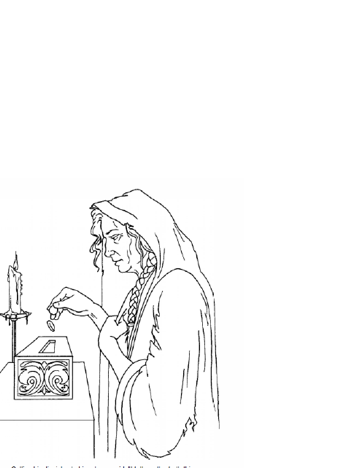
Mark 12: 38-44

Reflection for November 7, 2021 by the Rev’d Donald Brown

Today’s reading from Hebrews offers one doctrine in explanation of why Jesus died on the cross.

In this reading we are given a theology of atonement—that God caused Jesus to die as payment for the sins of humanity-past, present and future.

I say ‘one explanation’ because there are a number of other explanations which are part of our tradition. There is a growing consensus that Jesus was killed because of his radical teaching which offended both Jewish religious leaders and Roman authorities.

His summary teaching ‘love God, love your neighbour’ put forth an alternate visions of God and humanity.

Set out below are some thoughts on atonement by Bishop John Spong.—This too presents an alternate vision but also calls humanity to task for atrocities committed in the name of and/or sanctioned by Christianity as various points in history.

“What human life needs is not a theology of human denigration. That is what atonement theology gives us. What we need is a theology of human fulfillment.”–John Shelby Spong

“Atonement theology is not the pathway to life. The ability to give ourselves away to others in love is. It is not the winners who achieve life’s meaning; it is the givers. That is the basis upon which a new Christianity can be built for a new world. Atonement theology was born in Gentile ignorance of Jewish worship traditions. It was fed over the centuries by literalizing biblical narratives in ways that Jewish worshippers, who knew about storytelling, would never have understood. I say it again: Biblical literalism is nothing less than a Gentile heresy. Its results are now revealed in the fact that Christianity has been transformed into a religion of victimization. For centuries we have practiced our faith by building up ourselves as winners, survivors, the holders of ultimate truth, while we have denigrated the humanity of others. That is the source of evil. That is why Christianity has given birth to anti-Semitism. That is why the crusades were initiated to kill “infidels.” That is why we gave our blessing to such things as the divine right of kings, slavery, segregation, and apartheid. That is why we defined women as sub-human, childlike, and dependent. That is why we became homophobic. That is why we became child abusers and ideological killers.

What human life needs is not a theology of human denigration. That is what atonement theology gives us. What we need is a theology of human fulfillment.”

–John Shelby Spong, Biblical Literalism: A Gentile Heresy: A Journey into a New Christianity Through the Doorway of Matthew’s Gospel

John Spong does not ‘mince words’, does he?

Readings and Collect for the All Saints’, October 31, 2021

Collect

Source of all being,
beginning and end,
we praise you for those who have served you faithfully.
kFor the sake of Jesus Christ,
replenish our hope in your eternal kingdom,
that we may have life in all its fullness,
unfettered by the fear of death. Amen.

Readings

Wisdom of Solomon 3: 1-9

Psalm 24

Revelation 21: 1-6a

John 11: 32-44

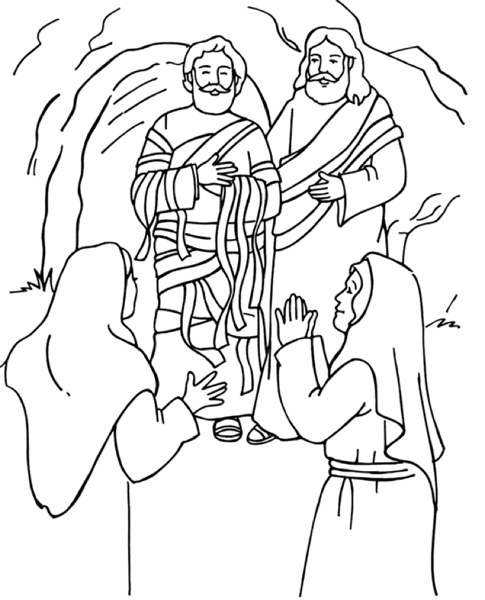
When Mary came where Jesus was and saw him, she knelt at his feet and said to him, ‘Lord, if you had been here, my brother would not have died.’ When Jesus saw her weeping, and the Jews who came with her also weeping, he was greatly disturbed in spirit and deeply moved. He said, ‘Where have you laid him?’ They said to him, ‘Lord, come and see.’ Jesus began to weep. So the Jews said, ‘See how he loved him!’ But some of them said, ‘Could not he who opened the eyes of the blind man have kept this man from dying?’

Then Jesus, again greatly disturbed, came to the tomb. It was a cave, and a stone was lying against it. Jesus said, ‘Take away the stone.’ Martha, the sister of the dead man, said to him, ‘Lord, already there is a stench because he has been dead for four days.’ Jesus said to her, ‘Did I not tell you that if you believed, you would see the glory of God?’ So they took away the stone. And Jesus looked upwards and said, ‘Father, I thank you for having heard me. I knew that you always hear me, but I have said this for the sake of the crowd standing here, so that they may believe that you sent me.’ When he had said this, he cried with a loud voice, ‘Lazarus, come out!’ The dead man came out, his hands and feet bound with strips of cloth, and his face wrapped in a cloth. Jesus said to them, ‘Unbind him, and let him go.’

Reflection for October 31, 2021 by Katherine Kerley

We have been reflecting a lot recently about who Jesus was as a person, both God and human. It’s easy to view Jesus as special, and having God-like qualities, but here in our Gospel reading this week, we are reminded again about the human nature of Jesus. Jesus had been friends with Mary and Lazarus for some time before we meet them here in this reading. In fact, we are told that he loved them. Jesus learns that Lazarus is sick, and so he travels to be with Lazarus and Mary, knowing that Lazarus has already died.

When things feel hard, no matter how much we feel like we are living in hell-on-earth, and I’m sure we have had those moments, we need to try and remind ourselves that there’s heaven-on- earth too.

When Jesus approaches the tomb of Lazarus and sees his friend weeping, and other friends of Lazarus weeping, Jesus is moved to tears himself. Even though he knows there is a plan for his friend and that his friend will live again, the grief and sadness expressed around him in that moment affects him deeply. The crowd remarks how Jesus must have loved this person so much that he is moved to tears, but I think there is more going on here. Jesus, in his true humanity, expresses empathy for his friend. He literally feels her pain and weeps with her in that moment.

I’m sure many of you have been to the funeral of a person you weren’t close with, and perhaps you’ve also experienced the same kind of empathy that Jesus did in that moment with Mary and the crowd at Lazarus’ tomb. In moments of collective sadness, we feel the grief of others deep in our souls. When a loved one gives a eulogy and describes the things that they will miss about someone, we are right there with them, imagining that person and the hole they will leave in the lives of those who had the privilege of knowing them. We weep along with those in the crowd because in a small way, we can take some of that grief from them and express it ourselves. That’s what empathy can be: feeling someone’s pain alongside them so that they can know they are not alone, thus easing the burden of their pain a little bit.

When we attend funerals, we are also reminded of everyone else we have lost and grieved our entire lives. Funerals let us process our own grief anew and freely express sadness and loss that we, by necessity, have had to push aside during our day-to-day lives. In those moments where we remember someone else, we remember ourselves and our own losses and let them flow with the others in the room. It is a collective release: a catharsis. We can imagine that Jesus was not only feeling the sadness that his friend felt in that moment, but also the weight of things that had already happened, and the weight of things to come.

All Saints’ Day seems particularly meaningful given the tone of our lives the past 18 months. There is so much grief in the world, so much loss, and a lot of pain and struggle. But we see Mary, even though she is upset, grieving, and angry at Jesus for letting her brother die, has faith that God and Jesus will make it right. She believes that even though there is pain now, that God will continue to be faithful to God’s people, and to Jesus.

The message of hope is one that can be difficult to focus on when we are so entrenched in our own challenges. We often tell folks that “it gets better”, but how is that helpful right now? We can hope that it gets better (or maybe we can’t, and that’s ok too) but we also need to figure out how to make the here and now better. In today’s reading from Revelation, we are told that “the home of God is among mortals” (21:3). I think this is really important to focus on: God dwells within us and around us always: God’s home is here. When things feel hard, no matter how much we feel like we are living in hell-on-earth, and I’m sure we have had those moments, we need to try and remind ourselves that there’s heaven-on-earth too. God’s home is here with us, and God is with us always. And when we are unable to see that or remember it, know that there are those around us who will sit and lament with us, and help share our burden when it feels too heavy for us to bear.

Treaty Recognition Week Event

Janis Kahentóktha Monture

In recognition of Treaties Recognition Week, we invite you to join Dean Tim Dobbin and Archdeacon Val Kerr on Wednesday November 3 at 7:00pm, for a conversation with Janis Kahentóktha Monture, the executive director of the Woodland Cultural Centre. Their conversation will be a wide-ranging discussion on the Woodland Cultural Centre, the Mohawk Institute Residential School, the Save the Evidence Campaign, and the ongoing Truth and Reconciliation process.

One of the largest First Nations-run cultural centres in the country, the Woodland Cultural Centre was established in 1972 upon the closure of the Mohawk Institute Residential School. An active volunteer in her community at Six Nations and in Brantford, Janis previously served as the director of tourism and cultural Initiatives for the Six Nations of the Grand River Development Corporation before joining the Centre.

You can participate in this livestreamed event by visiting the Cathedral’s YouTube page.

Remembering the Saints

We will be celebrating All Saints’/All Souls on October 31, and we want to sure to remember all of our Transfiguration “Saints”. If there are people in your life who have died, especially in the past year, and you want to commemorate in this special service, please email the office with their names, and they will be included on special slides during the service.

Thank You

Garden2021

A note from Ray: Thanks be to God, and to those who helped with the garden this year! This is the last bunch of peppers picked last week by, John, Emmett, Nancy and Ray. Dropped them off the Community Care Friday morning. They were very thankful. Cheers! Ray

Readings and Collect for the Twenty-second Sunday After Pentecost, October 24, 2021

Collect

O Jesus Christ, teacher and healer,
you heard the cry of the blind beggar
when others would have silenced him.
Teach us to be attentive
to the voices others ignore,
that we might respond
through the power of the Spirit
to heal the afflicted
and to welcome the abandoned
for your sake and the sake of the gospel. Amen.

Readings

Job 42: 1-6, 10-17

Then Job answered the Lord:
‘I know that you can do all things,
and that no purpose of yours can be thwarted.
“Who is this that hides counsel without knowledge?” Therefore I have uttered what I did not understand,
things too wonderful for me, which I did not know. “Hear, and I will speak;
I will question you, and you declare to me.”
I had heard of you by the hearing of the ear,
but now my eye sees you;
therefore I despise myself,
and repent in dust and ashes.’

And the Lord restored the fortunes of Job when he had prayed for his friends; and the Lord gave Job twice as much as he had before. Then there came to him all his brothers and sisters and all who had known him before, and they ate bread with him in his house; they showed him sympathy and comforted him for all the evil that the Lord had brought upon him; and each of them gave him a piece of money and a gold ring. The Lord blessed the latter days of Job more than his beginning; and he had fourteen thousand sheep, six thousand camels, a thousand yoke of oxen, and a thousand donkeys. He also had seven sons and three daughters. He named the first Jemimah, the second Keziah, and the third Keren-happuch. In all the land there were no women so beautiful as Job’s daughters; and their father gave them an inheritance along with their brothers. After this Job lived for one hundred and forty years, and saw his children, and his children’s children, four generations. And Job died, old and full of days.

Psalm 34: 1-8

Hebrews 7: 23-28

Mark 10: 46-52

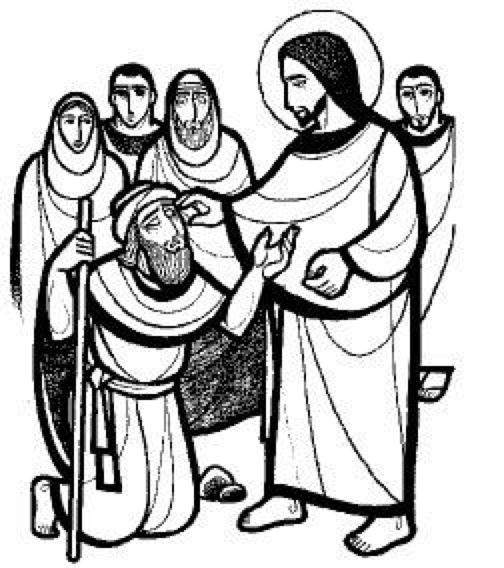
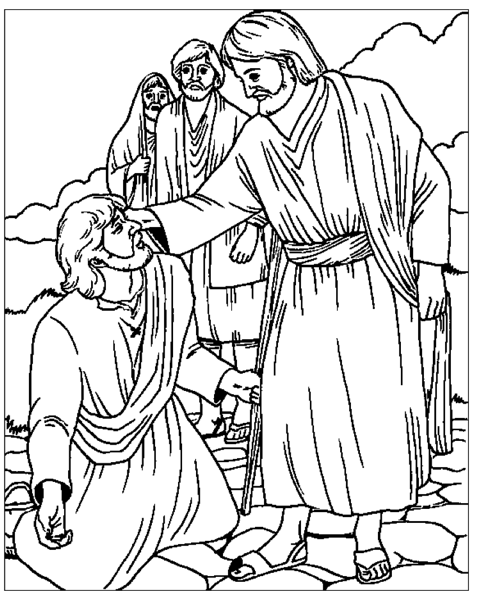
They came to Jericho. As he and his disciples and a large crowd were leaving Jericho, Bartimaeus son of Timaeus, a blind beggar, was sitting by the roadside. When he heard that it was Jesus of Nazareth, he began to shout out and say, ‘Jesus, Son of David, have mercy on me!’ Many sternly ordered him to be quiet, but he cried out even more loudly, ‘Son of David, have mercy on me!’ Jesus stood still and said, ‘Call him here.’ And they called the blind man, saying to him, ‘Take heart; get up, he is calling you.’ So throwing off his cloak, he sprang up and came to Jesus. Then Jesus said to him, ‘What do you want me to do for you?’ The blind man said to him, ‘My teacher, let me see again.’ Jesus said to him, ‘Go; your faith has made you well.’ Immediately he regained his sight and followed him on the way.

Reflection for October 24, 2021 by the Rev’d Sheila Van Zandwyk

There is so much going on in this brief story about Bartimaeus the blind beggar which is par for the course in Mark’s gospel. I want to focus on a couple of moments of action which captured my attention. The first one is the quick turn around of the crowd and their dealings with Bartimaeus. When Bartimaeus begins shouting to gain Jesus’ attention the crowds are so dismissive of him, sternly telling him to be quiet. The word sternly is indicative of their distain that this blind beggar, a person of no importance and in fact someone who is generally to be ignored should have the audacity to try to speak to Jesus is so clear. It is like an adult who finds children to be a nuisance rather than a joy, telling them to be quiet when the grown-ups are talking. Then how quickly their response to Bartimaeus changes when Jesus not only hears his cries but pointedly stops walking and asks to have the man brought forward. Now they tell the beggar to “Take heart, he is calling you.” How quickly public opinion changes when a different light is shone on a person or issue. With the focus and interest of Jesus now pointed at Bartimaeus the crowd reacts very differently to him, now they are quite solicitous and kindly, whether because they are aware of what Jesus has been hearing them say to Bartimaeus and are trying to cover it up or because the fact that Jesus is interested in this man has changed their opinion of him. When we look at people and issues through the lens of the love and kindness of Jesus our view can be changed quite drastically. The ‘homeless people living in public parks’, issue becomes a call for justice for all God’s people, a chance to reach out to those in need in a kindly and caring way to find help for their suffering. They are no longer homeless people but God’s children and therefore our brothers and sisters and that immediately changes the way we see them and treat them.

The second thing I want to look at in this passage is Bartimaeus’ reaction to Jesus’ call. Mark writes, “throwing off his cloak, he sprang up and came to Jesus”. There is such an immediate and powerful reaction from Bartimaeus when he hears that Jesus is calling him. He throws off his cloak and springs up and goes to Jesus. If his cries to Jesus for mercy do not reveal his faith, then the actions he makes when Jesus hears him and calls to him definitely do. The throwing off of his cloak is like he is shedding his former self, ‘blind beggar’, recognizing that that is not the way Jesus sees him. His springing up shows his joy and excitement in the chance to speak to Jesus directly and his going to Jesus reveals his desire to be right in the presence of the one he calls ‘the son of David’, the anointed servant of God Almighty. Then Bartimaeus goes further, he follows Jesus on the way.

Oh, that we could react in the same way when Jesus calls us. Whether it is Jesus calling us to stand up for the poor, oppressed and voiceless in our society or whether it is Jesus calling us into a particular role or work within the church or our community. May we be courageous enough to call out to Jesus, expect to receive a reply, listen when Jesus calls to us, throw off our cloaks of self-consciousness, doubt or fear, spring up and go to Jesus. Knowing that when we do, if there is anything we will need help with Jesus will give it to us just as he gives Bartimaeus the gift of sight when he asks for it and knowing that Jesus will lead us where we need to go and walk with us all the way. Amen.
Reflection20211027

The Social Justice Bible Challenge Study

Join me for 5 weeks as we read together the Social Justice Bible Challenge. Each day for 40 days there will be a short Bible passage and a reflection to read that focuses on Social Justice. We will meet each Wednesday beginning on October 20th at 11:30am in the fireside room. The books are $20.00 each. Please call or email me if you are interested.
Rev. Sheila